
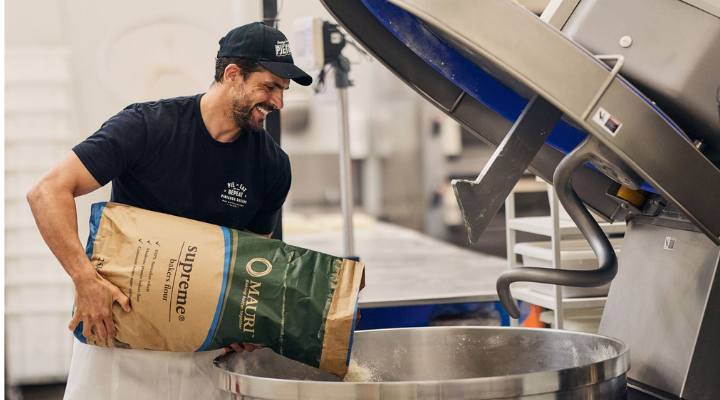

Daniel Pantaleo leads franchising, strategic planning and digital innovation at the 29-year-old Pinjarra Bakery chain in Western Australia. Here he shares how this legacy family business is making sense of a fast-changing technology landscape.
How are you using customer-facing technology?
Our focus has been on our VIP rewards system, which we started in 2019; it now has more than 60,000 members. This is a points-based system: customers spend and gain points which they can redeem for free product, vouchers or merchandise. We gift customers who have completed a profile a free cake on their birthday.
The loyalty program allows us to track purchases, and as a customer touch point the technology has really helped us.
Customers using the loyalty program can give feedback after every transaction. From a feedback perspective we like this; it keeps the conversation inhouse rather than on Google. We have the chance to review and follow up, and resolve issues directly with our customers.
How do you match streamlined and efficient tech tools with customer engagement?
It’s a deliberate choice to keep technology in the background rather than front and centre; it preserves the human connection that keeps customers coming back.
We tell team members that every time a customer walks through the door it is the perfect opportunity to make their day better. We can’t measure that ripple effect.
Of course, in food manufacturing there are so many opportunities to improve consistency and efficiency. Although there is a fine line between handcrafted niche and mass produced baked goods manufacture. We never want to lose that focus, we pride ourselves on being a hand-made product.
Technology is very useful for any administrative task – ordering products for instance. It’s so easy for franchisees to order; we have an online portal that puts orders direct to the bakehouse distribution team and they begin the packing process.
How do you keep up with tech advancements?
It starts with identifying the problem. Is there a bottleneck? Can technology solve it? I research and find the options and then we test in our stores first, to iron out the bugs.
There’s been an exception to that with a franchisee who wants to bring on a food delivery platform. We are collaborating on this to see what’s involved.
There are so many solutions it can be hard to determine whether a new program or platform is worth investing in until you apply your own data – that gives you the opportunity to more effectively analyse the technology.
From a reporting perspective you can deep dive into everything and filter results according to the weather, the season, the time of day. The more experienced we get with the data, the easier it is to maximise the technology.
Through our business review process, we benchmark everything. We give franchisees access to their own data; every store has its own vibe and when you benchmark, it gives you the chance to see where they are succeeding and where they might be falling short.
We deep dive into this with franchisees, and start a conversation about how to make improvements.
How do you see AI affecting your business processes and systems?
One thing AI has allowed us to do is create custom applications. As a small business, we don’t have the resources to build proprietary systems, so AI has reduced the opportunity cost.
We have our own AI model, trained on our operations manual, training, policies and procedures. This means franchisees can ask any question and get an answer. Of course, it’s AI, so we also point them back to the reference points in the manuals to double-check the response.
We’re also using a simple AI tool we’ve created that checks supply invoices and flags any price change. It’s been super helpful and efficient.
And we are developing a franchise support hub to track the journey through recruitment, store fit out, onboarding and training, in one central platform.